

I’m assuming that, right now, you have (at least) one 2026 strategy document open on your laptop. It’s also likely that, by the time you close that strategy document, some of the insights powering it will already be out of date.
Making time to regularly reflect on and update the foundations of your strategy is crucial to ensure you’re always making decisions with the best and latest information - and not just once a year.
But how do you actually carve out regular time to do this when your diary is packed and your attention span is fried?
BJ Fogg, author of Tiny Habits, identifies three steps to creating a habit:
Motivation - a clear understanding of why you want to build this habit
Ability - the habit needs to feel small, easy and compatible with our current routines
Prompt - a clear timely cue that tells you ‘do it now’
Based on this, I’m sharing a suggested recipe for developing and sustaining a strategic reflection habit to help you keep your strategy fresh and you armed with the latest insights for influencing your team, stakeholders and executives.
Like any recipe, there might also be ingredients that you might want to add more of less of to suit your palate and appetite for spice!
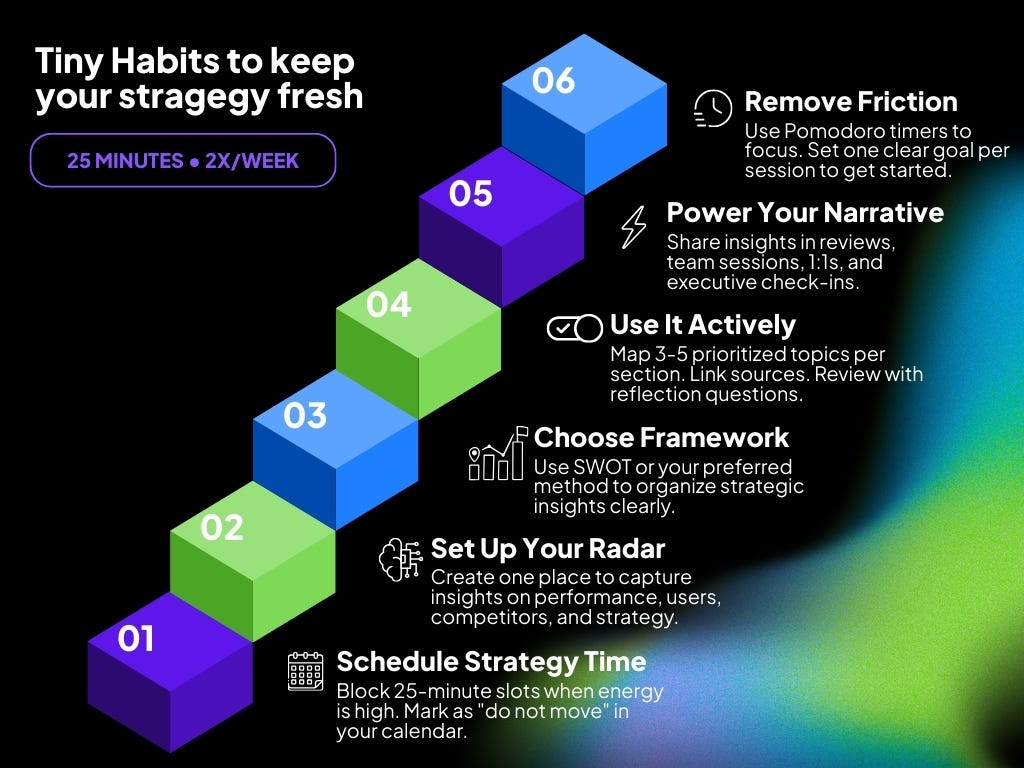
1. Schedule regular strategy time
Aim for just 25 minutes (the perfect ‘tiny’ slot) once or twice a week when your energy is high and you can block out distractions.
Put it in your diary as a regular block and call it something like ‘Important strategy session - do not move’ to show both you and others that this isn’t a slot to be messed with.
2. Set up your strategic radar and in-tray
In the course of your day, you likely come across information about product performance, user behaviour trends, competitor launches, and company strategy changes, which are all crucial to your product’s strategy.
When your strategy radar picks up something which could be useful, immediately put it in a single place - a document, notes tool, spreadsheet, task list or email folder - to make it easy to find a process when you have time.
3. Find a framework to organize your strategic insights
You may have a preferred strategic framework but if you don’t, a classic that I love is a SWOT analysis. Its four quadrants enable a holistic overview of the internal and external forces impacting your product:
Strengths - internal factors which give an organization or product/team an advantage (such as unique tech capabilities, people, skills, IP, brand reputation)
Weaknesses - internal factors which place the organization or product/team at a disadvantage (such as limited resources, lagging technology, declining user satisfaction)
Opportunities - external factors which could be catalysts for growth (such as emerging markets, favorable regulations, new technology trends)
Threats - external factors that could cause problems or decline (such as increased competition, economic downturn or changing customer preferences)
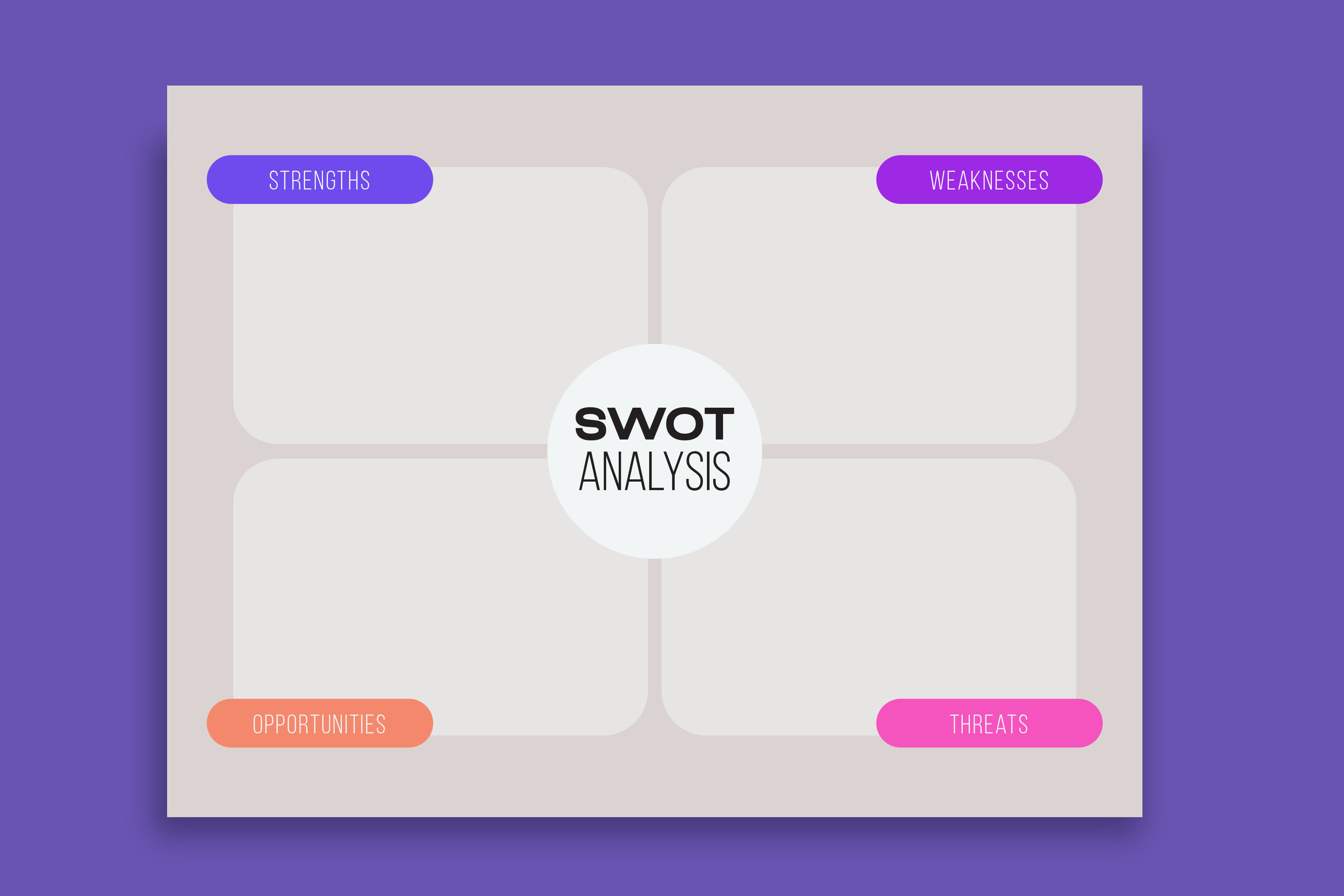
By clearly separating internal capabilities from external conditions, you can make informed decisions about where to invest.
For example, you can see how to use a strength to capitalise on an opportunity, or how to mitigate a threat by addressing an internal weakness.
4. Actively use the framework
Create a document/slide/spreadsheet with your preferred strategy framework and map what’s powering your existing strategy.
Aim to have 3 to 5 topics in each section and rank them in priority order (with the top being the most impactful and likely).
Link to the sources for each statement to help you track where they came from.
Once you have a completed template, reflect on the following questions:
Insight freshness and completeness
What new information have I learned since I created the strategy which I should add?
Where might I have blind spots and should schedule some proactive research?
Who could I talk to to get fresh perspectives and insights?
Insight significance
Should the priorities in each section change?
Is anything now more or less important?
Should anything be completely removed now?
Insight impact
What have I learned from doing this?
How might this impact my current strategy?
How might this impact current and future priorities?
Is there anyone else who would benefit from knowing about this?
5. Power your strategic narrative with your learnings
Through this exercise, you’re building up a coherent, research-based narrative to underpin your strategy and prioritisation.
So think about where you can make use of it to give your decisions and direction more credibility .
Places to use it might include:
Updates to the annual strategy
Monthly and quarterly business reviews
Onboarding new team members and stakeholders
All team sessions
1:1s with team members
Check ins with executives and skip leads
You might also decide to make the review and updating of the SWOT a team activity to regularly freshen up the shared understanding of your team’s why.
6. Identify and address the friction points
If you’re struggling to keep the habit, explore what’s getting in the way and how you could remove those blockers.
If you really struggle to focus, try setting a Pomodoro timer and aim to not check your emails, messages TikTok until the timed session is finished.
If you struggle with getting started then write down one goal to achieve in the session, Make it time-based (I will spend 25 minutes researching x), task-based (I will go through everything in my insights in-tray), or deliverable-based (I’ll use GenAI tool to create a list of online competitive insight sources).
Just like your strategy itself, building a habit around continuous strategic reflection can help you strengthen clarity and focus.
And by approaching your habit building with curiosity, compassion and a willingness to experiment, you’ll build sustainable habits that will have a lasting impact on your impact as a strategic leader.
More about us
ProductLab’s community events are a great way to get inspired by the leadership and learnings of others, listen to compelling storytellers, and build your trusted network.
In 2026, ProductLab will launch Leaders Studio, bringing together product leaders from corporates and scale-ups (in separate groups) to define, explore, and achieve their career goals with the guidance, challenge, and support of a trusted peer network.