

The job title is stable. The job description is not.
I’ve been running Productlab for two years, talking to senior product people every week across Leaders Circles, the community, and the conference circuit. And something I keep seeing doesn’t have a clean name yet. The people in the room are all called product managers. But they’re not doing the same job anymore. They don’t want the same things from their career. They don’t need the same skills. And the gap between them is growing.
Let me try to put a frame on it.
How we got here
Two years ago, the dominant question was “what is AI and should I care.” That wave produced credentials, explainers, bootcamps. Most of it was behind where the actual work was already happening.
Last year the question changed. Teams started shipping real AI features and hit the same production walls across every industry. How do you evaluate a system whose outputs are never identical twice? How do you design an agent that isn’t just an expensive autocomplete? How do you build something users trust enough to act on? The teams that moved fastest weren’t the ones with the best tools. They were small, cross-functional, and led by people with specific domain knowledge that the model couldn’t replicate on its own.
Now we’re in a third shift, and it’s the hardest one. The question is no longer technical. It’s organizational. When everyone can build, what is actually yours? When building speed is no longer the differentiator, what is?
That question is reshaping what product management actually means. And it’s producing three distinct profiles.
The three product managers
The first is what I’d call the Operator. They use AI to do the existing PM job faster and better. PRDs in twenty minutes. Research synthesis in two hours instead of two days. Meeting prep automated. Customer interviews summarized before the call ends. This is genuinely valuable. The work is real and the efficiency gains are measurable. But the playbook is visible to everyone, and so is the tool being used to run it. The efficiency is not a moat.
The second is the Product Builder. This person has shipped something real with AI. They know what evaluation systems are because they’ve needed them, not because they read about them. They’ve hit the production wall where a feature that works perfectly in a demo produces garbage in the wild. They’ve had to redesign a workflow from scratch because the architecture they chose was impossible to debug when it failed. They think about prompt engineering at the production level, not the conversational level. They’re T-shaped: enough technical fluency to make real architectural decisions, enough product craft to stay focused on the user problem. This is the direction individual product contribution is heading. It’s smaller than it looks. A lot of people believe they’re here when they’re still in the first group.
The third is the Specialist. This person has gone narrow and deep, combining AI capability with domain expertise that’s genuinely hard to replicate. A former teacher who writes her own evaluation code specifically because she knows what good pedagogy looks like and a generic model doesn’t. A product leader who spent years working with local government who knows that “this is a really big problem” is positive sentiment in civic technology, not a complaint, and that no off-the-shelf model will catch that distinction. Their competitive advantage isn’t the tools they’re using. It’s what they already know that the tools can’t. This is the rarest profile, and the gap between them and everyone else is widening, not closing.
How skills are actually changing
The skills that are losing value are, uncomfortably, some of the skills that got people promoted in the last decade. Writing detailed requirements that get handed to an engineering team. Being the translator between business and technology. Managing a backlog as the central organizing activity of the job. These aren’t gone. But they’re no longer the differentiator.
What’s becoming more important, not less: taste and judgment, because when anyone can build anything quickly, the decision about what’s worth building becomes the job. Domain expertise, because AI amplifies what you already know and can’t substitute for it. Commercial thinking, because the best product people now think about positioning, pricing, and go-to-market as product decisions, not someone else’s problem. And communication, which sounds obvious until you realize that as AI handles more of the execution layer, the human ability to facilitate alignment, challenge assumptions in a room, and build trust under pressure becomes the actual leverage.
The genuinely new skills are real but learnable: designing AI systems that degrade gracefully rather than confidently wrong, building evaluation infrastructure that isn’t just a spreadsheet of thumbs-up ratings, understanding how context windows fill and degrade so you design workflows that account for it. The most honest thing I’ve read about this is that you can’t predict how long it will take to get to good. Getting to good takes a lot of iteration. The knowledge lives in the failures already made, not in the frameworks describing them.
Why we designed three days
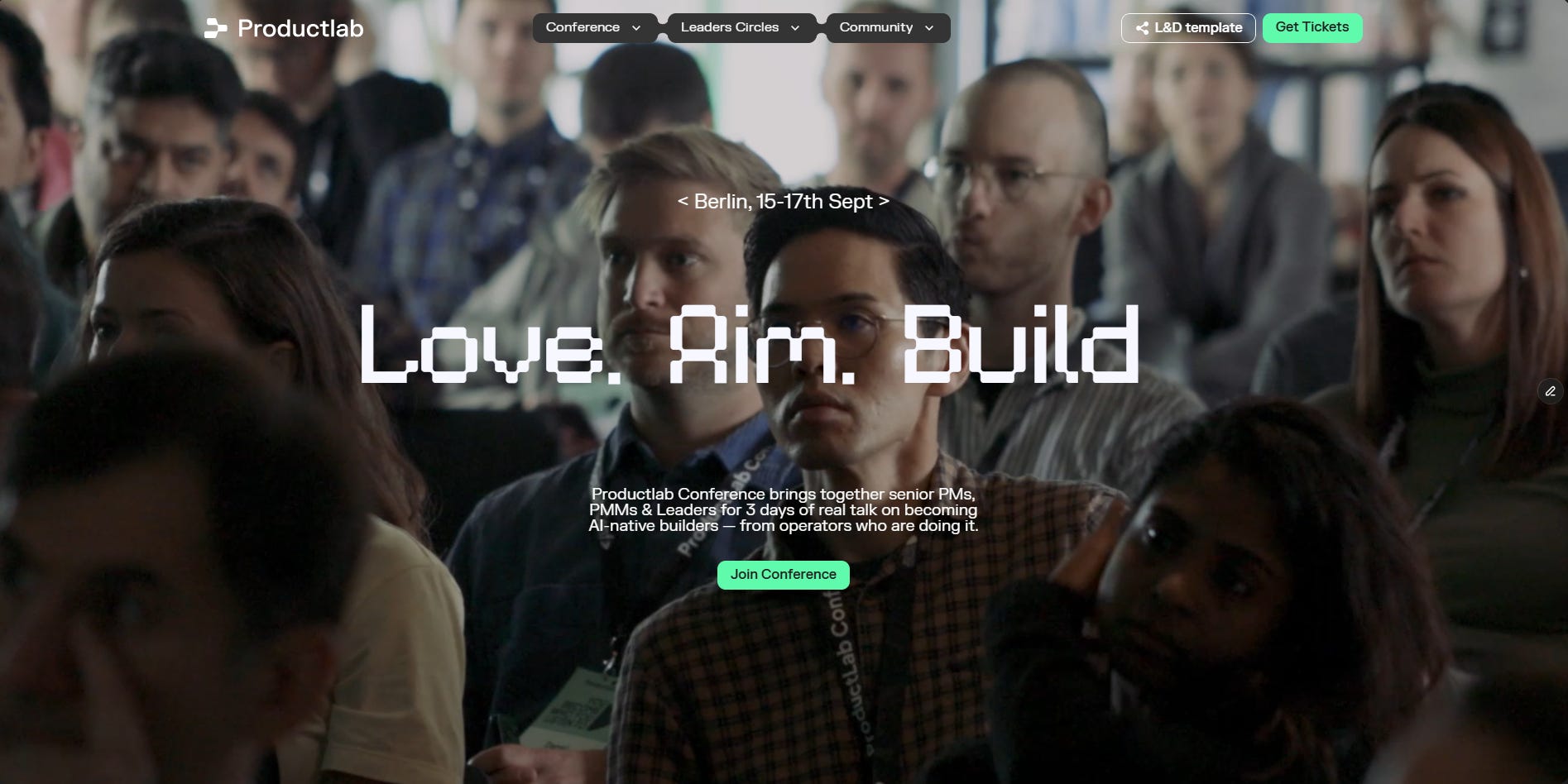
The conference structure is a direct response to these three profiles and the organizational layer that sits above all of them.
Day one is for the leaders trying to navigate from the top. The question is: given that the rules are changing faster than any planning cycle can accommodate, how do I make directional decisions without waiting for clarity that won’t come? We called the best person we know to lead that conversation: Ravi Mehta, who has spent the last two years building the most widely used framework for executive AI strategy and building AI-first teams. Not a lecture. A working session with people who have the same problem.
Day two is a full operating system for the Builders and Specialists. Six workshops, maximum twenty people each, at The Social Hub. Not lectures, practice. The new execution layer: agentic system design, building a personal Product AI OS, discovery and validation at AI speed. The judgment layer that hasn’t changed: stakeholder communication, strategy-to-execution, go-to-market thinking.
The people running the rooms: Zsuzsanna Tamas (Amazon Music) on agentic AI architecture. Tamer El-Hawari (Productbench) on building your Product AI OS. Birte Loecked on discovery and validation under pressure. Rich Mironov on ROI and managing business demands. Tim Herbig on connecting strategy to measurable execution. Rory Woodbridge on product marketing and go-to-market. Six practitioners, six rooms, maximum twenty people in each. One day to upgrade both sides of the equation.
Day three is the room where all three profiles are in conversation. Morning: companies and practitioners showing what the new terrain actually looks like when you’re operating inside it. Afternoon: the practitioners who went first, with the real stories. What the AI-native playbook doesn’t tell you. What it takes to build 0-to-1 agentic products inside a large organization. What happens when complexity is your moat and your end user isn’t your buyer. Then we close with something that isn’t a talk at all, a live robotic music performance exploring what happens when human intent meets algorithmic agency and neither is fully in control. It’s the honest description of where we all are right now.
Not three days of content. Three days designed for the three conversations that actually move people.
Which profile are you building toward?
With love from Berlin,
Daniele