

What the event was
Eight speakers across one day. Eric Ries (Lean Startup, Incorruptible) opened. Then Jefferson Rabb (CPO, Business Insider), Carlos Gonzalez (founder, Product School), Penny Szeto (Head of GenAI, Amazon Games), Vinod Suresh (VP Product, GoDaddy), Mathias Davidsen (VP Prototyping, Miro), Meaghan Choi (Head of Design, Anthropic), and Fonda Jam (PM, Intuit).
The stated theme was AI in product. The actual theme, once you stepped back from individual talks, was more uncomfortable: what breaks in a product org when AI works.
Not if it works. When.
Where the market actually is
Vinod Suresh from GoDaddy said it plainly at the start of his talk:
“AI has definitely taken away a product manager’s favorite excuse: limited engineering bandwidth.”
He framed the structural shift this way: the whole product development lifecycle was built on one assumption, that engineering bandwidth is the most expensive and most limited resource in any company. Supply and demand governed the roadmap. That assumption is no longer true.
The data backs this up, but with an important asterisk. CircleCI’s 2026 State of Software Delivery tracked 28 million CI workflows. Overall activity is up 59% year-over-year. The top 5% of teams nearly doubled their throughput. But the median team improved by only 4%. And on the main branch, the code that actually reaches production, throughput fell by 7%. Main branch success rates are at 70.8%, the lowest in five years.
Fewer than 1 in 20 teams have figured out how to ship at AI speed.
The same gap shows up organizationally. An NBER study of 6,000 executives across the US, UK, Germany, and Australia found that 80% of firms report zero measurable productivity gains from AI. Goldman Sachs puts median productivity improvement in software development at 30%. The gap is not between AI and no-AI. It is between the 5% who restructured for it and the 95% who added tools to an org built for a different era.
Carlos Gonzalez from Product School named this the false summit. Individual productivity rises fast. Team and business outcomes stay flat. Most product orgs are stuck there right now.
Three things that stuck
1. AI is making individuals more confident and organizations less coherent at the same time.
Mathias Davidsen from Miro gave the sharpest diagnosis of the day:
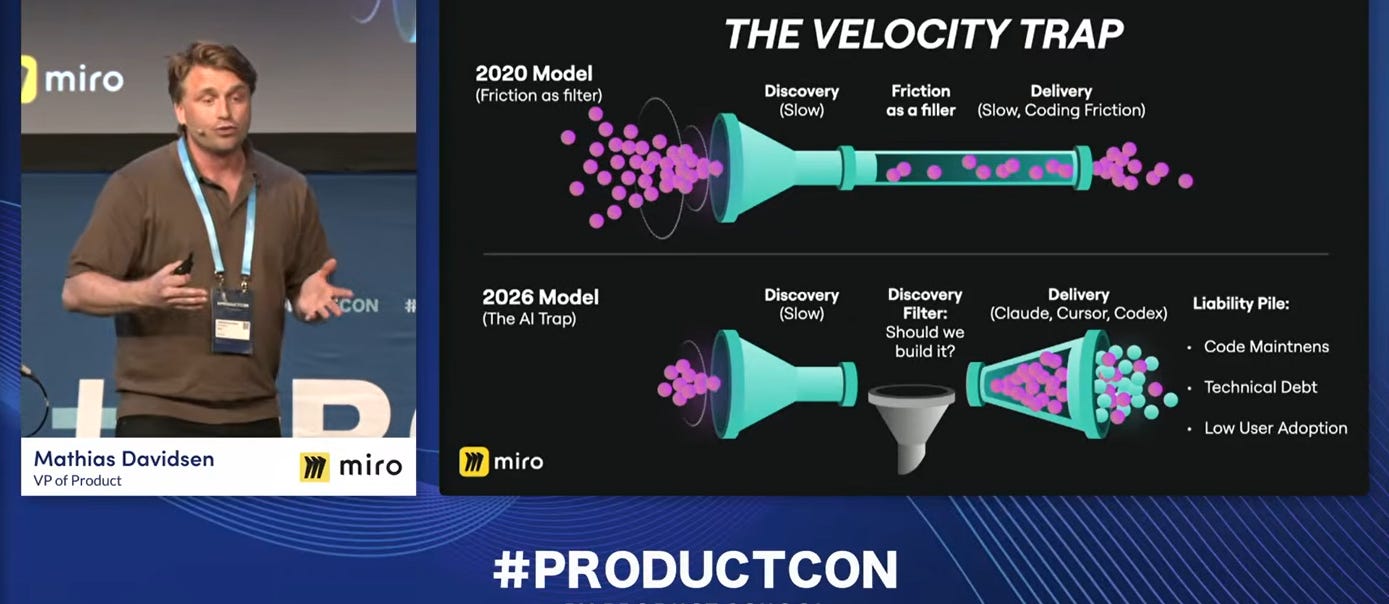
“AI has massively raised the floor. One person and their agents has become the most powerful creative unit that has ever existed. But when we zoom out from the individual to the wide organization, we don’t really see the results follow. Company output hasn’t 10xed. Strategic clarity hasn’t 10xed.”
The mechanism: when someone is pointed in a slightly wrong direction, AI amplifies that by moving fast and constantly agreeing. His framing of the result:
“Six people, six AI co-pilots, six confident, polished, and completely divergent strategies.”
“We’re no longer potentially building one wrong thing slowly. We’re potentially building a hundred wrong things very quickly and we’re not even aware of it.”
“The bottleneck moved from ‘can we build it?’ to ‘are we choosing the right thing to build?’ And when you’re planning, your competitor is shipping.”
The old buffer was the planning cycle. The forced alignment moments. Those are gone. What replaces them is not a tool. It is a leadership function.
2. For customer-facing AI, the model is the least important decision you will make.
Penny Szeto from Amazon Games built a generative party game with Snoop Dogg as an AI celebrity judge. Entirely new court cases, live dialogue, new visuals every session in real time. In building it, she ran into something that should make every PM uncomfortable: reducing latency was hurting the experience. Snoop was responding so fast the jokes didn’t have time to land.
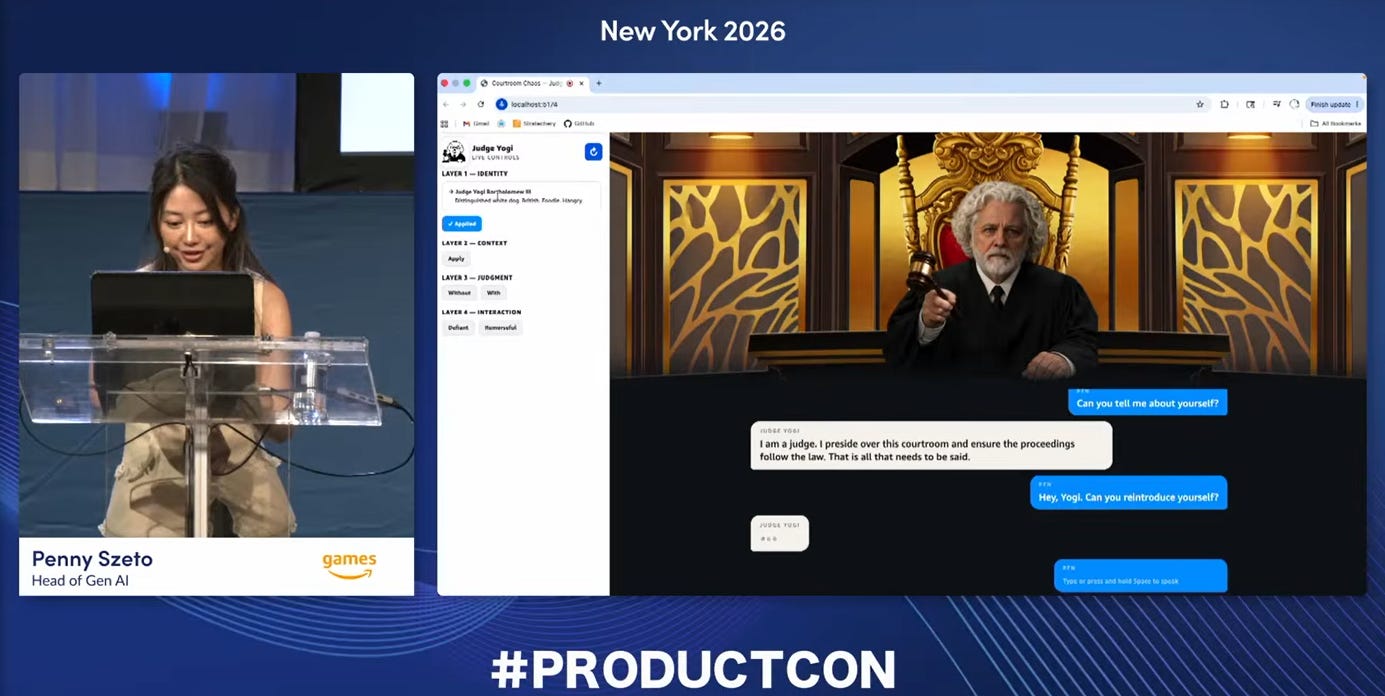
She referenced the Eliza Effect, a 1966 MIT chatbot that had no intelligence at all and yet people fell in love with it. Her point: the human instinct to anthropomorphize AI has gotten stronger with more capable models, not weaker. Your customers will form a relationship with your AI whether you design it intentionally or not.
Her framework for what actually determines customer AI experience, none of which is the model: Identity (who is your AI and what character does it have), Context (what does it know, what does it remember), Judgment (your guardrails, your values, your policy), and Interaction (pacing, tone, emotional calibration).
The model is table stakes. The product is everything built around it.
3. Only 16% of the world has actually used generative AI.
Fonda Jam from Intuit said something that cuts through the noise:
“As of late 2025, only about 16% of the world has used generative AI at all. One in six people out of six billion people who are online, fewer than 1.1 billion have tried it. You are at a ProductCon conference watching a recording about Claude Code. You are not behind. You are early.”
She also said the thing that gives the PM role its clearest new shape:
“For the first time in the history of software, the person with the product information can produce working artifacts without waiting on engineering bandwidth. The product manager who can build does not replace their triad. They make their whole triad faster.”
The one job AI will never take
Vinod Suresh from GoDaddy ended his talk with this:
“That is one job that AI can never take away from any of us: aligning finance, sales, marketing, tech, product, and go-to-market. Because those are people. To bring those people together still takes a human.”
Eric Ries opened the day with a connected thought, using the story of Sol Price who founded FedMart in the 1950s with a lawyer’s logic: the customer is the client, I have a fiduciary duty to the client. Price built a company that made shareholders rich for 20 years, then got fired by them. The company went bankrupt within seven years. Sol went upstairs, started Price Club, which eventually merged to become Costco.
Costco is a $400 billion public company that has kept its commitment to customers for 40 years. Ries’s argument: it survives because it has both the ethos and what he calls structural integrity, a governance architecture that resists the pressure to deviate from the mission.
“If you have a mission statement but not a mission, then you are lying to your customers.”
He mentioned he played a role in setting up Anthropic’s governance structure. The connection to every other talk on AI was not coincidental.
My takeaways
The constraint moved. It was engineering bandwidth. It is not anymore.
Ries’s word for what Costco built is worth sitting with. Not a mission statement. A governance fortress: a structure designed to hold its direction even when financial pressure, a bad quarter, or a fast-moving competitor creates urgency to ship the wrong thing faster. For product teams, that is not abstract. It means the decision-making layer is designed to resist drift, not just respond to it.
Davidsen called the planning cycle a buffer. It is gone. What needs to replace it is a clarity infrastructure, a shared source of truth that keeps six people with six AI tools pointed at the same thing. Not another tool. A practice. Explicit, repeated alignment on what is actually being built and why, before the agents run.
The 1 in 20 teams that figured out how to ship at AI speed built both things. The governance layer that holds direction under pressure. The alignment layer that keeps the whole org pointed at the same thing as execution accelerates. A product org that can make good decisions faster, not just execute faster.
What that looks like in practice in scaleups like yours, Zalando or N26, a Series B company, nobody said clearly. Not at ProductCon. Not in the research I read after.
It is the question we structured our own conference around.
Leaders Day on September 15 is curated by Ravi Mehta for Heads of Product and CPOs planning AI strategy and building AI-native teams.
Craft & AI Lab on September 16 is a full day on building AI products, getting faster with AI tools, and the judgment and strategy the tools will not give you.
Conference Day on September 17 runs three layers in parallel: a main stage with opening and closing keynotes reflecting on where we are and how this year is different, deep dives for 30 to 50 people going properly into the hard topics, and roundtables for 12 for the deeper, more personal conversation about your professional journey.
We curated this around the people actually moving in this direction.
Daniele Ronca is the founder of Productlab: Europe’s product leadership platform. Productlab runs the annual flagship conference in Berlin, the Leaders Studio coaching program, and a year-round community of 3,000+ senior product professionals. With love from Berlin.