


When Bandan Singh moved from Gojek to Booking.com to Rivety, he thought product management was all about user growth and conversion optimization. MAUs, DAUs, experiment after experiment—that was the game.
Then Rivety handed him full P&L ownership.
“I told the company hey I’ve never handled a P&L are you sure you want me,”
Bandan said at ProductLab Conference 2025 in Berlin. They wanted him anyway. Either he’d learn something new or he wouldn’t last long at the company. He survived 3 years—and discovered that product management had been missing half the equation.
At ProductLab, Bandan shared the hard-won lessons from managing profitability while everyone around him was still obsessing over growth metrics. This wasn’t theory. This was a product leader who learned to kill products, redesign pricing, and make layoff decisions—all while keeping the product organization healthy.
“Product management has just been too much about customer delight. Sustainable businesses are also about building a business at the end of the day.” — Bandan Singh
The Trap Most Product Managers Fall Into
Bandan’s career mirrors what’s happening across the industry right now.
At Gojek (Southeast Asia’s competitor to Uber and Grab), he was the “cool growth guy.” Small tweaks in the customer journey brought more users. The company was preparing for an IPO. Topline was everything—valuation was key.
Everything was about expansion, not efficiency.
At Booking.com, he learned experimentation at scale. How a small button change could move conversion numbers. But he never connected his work to the bottom line. He had no idea what his actual contribution was to Booking.com’s profitability.
“I would not know what led to true value for the company like what was my contribution in terms of the bottom line.”
Then came Rivety, a B2B mobility payments company in Berlin. Full P&L ownership meant looking at parts of the organization where he had no direct authority—but was responsible for outcomes anyway.
The learning curve was brutal. Pricing. Killing unprofitable products. Managing costs below revenue. Client-level profitability.
And yes, layoffs.
“The honest truth about a lot of hard decisions in companies—layoffs being one of them—they all come from a P&L decision.”
Action item: Stop measuring your impact solely by user metrics. Start asking: “What’s the actual revenue impact of what I’m building?”
Why Everything Changed (And Why It Matters for You)
Between 2018 and 2025, Bandan watched the entire product management playbook flip.
Money is no longer cheap. Companies that went public with “we’ll be profitable one day” promises are now scrambling to actually deliver profitability. Gojek, Grab, and dozens of others—they all said scale would solve everything.
It didn’t.
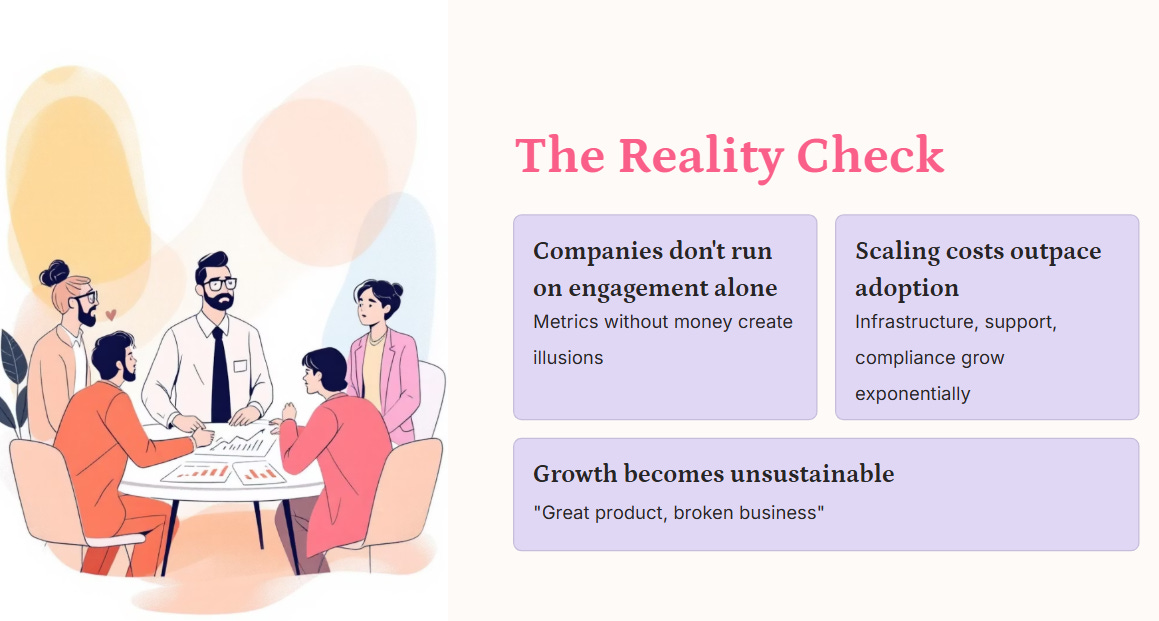
“Today if you look at Gojek and it’s true for a lot of companies that did IPOs recently now they’re all looking for profitability.”
The macroeconomics are tough. AI is accelerating this shift—it’s about value creation but also about cost-saving. Retention becomes more important because it brings you closer to profitability. Customer lifetime value matters more than vanity metrics.
Looking back, Bandan realized what he’d do differently at Gojek: track the cost of acquiring users.
“We don’t know at what cost we are acquiring users. I mean you have given me this team, you have given me these engineering resources and UX. I work with them and I deliver it and I get some monthly active users. But I would rather say that can we look at the cost of acquiring those users so that at least at a user level I know the unit economics.”
The shift for product managers: If you want to be successful—especially in senior product roles—you need to focus on business viability as much as customer delight. Maybe even overindex on business viability for a while.
Action item: Calculate your user acquisition cost. If you’re in a product-led company and it’s “spread across the full product base,” work with your finance counterpart to estimate it.
The Framework: 4 Levels of Looking at Profitability
Bandan broke down the P&L into a simple framework that any product manager can use—even if you don’t have full P&L access.
He showed a mock-up of what he was responsible for at Rivety. The key insight: different profitability metrics serve different purposes.
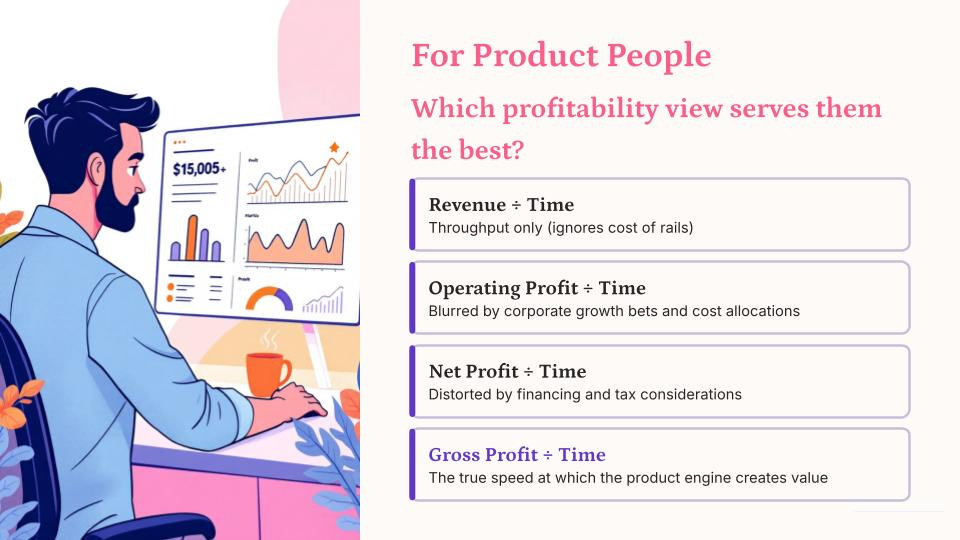
1. Revenue ÷ Time (Throughput)
This ignores the cost of rails entirely. It’s pure throughput.
Most product managers stop here. They celebrate when revenue goes up. But this metric is incomplete—it doesn’t tell you if you’re actually creating value for the business.
2. Operating Profit ÷ Time
This gets blurred by corporate growth bets and cost allocations.
It’s useful for CFOs, less useful for product teams making day-to-day decisions about what to build.
3. Net Profit ÷ Time
Distorted by financing and tax considerations.
Again, not the right metric for product decisions.
4. Gross Profit ÷ Time (The One That Matters)
“The true speed at which the product engine creates value.”
This is where product managers should focus. Gross profit strips away the noise and shows you: is this feature, product, or initiative actually creating value for the business?
Bandan’s rule: Take revenue, subtract direct costs (COGS), and you get gross profit. That’s your North Star.
“At a given point in time it’s important to know what is more important for the organization—is it gross margin or is it net? Depending on what the company is striving for, that is the more important metric.”
Action item: Find your product’s gross profit metric. Work with finance to understand your direct costs. Start tracking gross profit ÷ time as your primary business health metric.

The Numbers That Actually Matter
When asked about how to start thinking about profitability, Bandan shared two calculations that changed how he prioritized work.
Profit Velocity: Gross profit per week or per sprint.
This tells you how fast your product is generating value. It’s not about the absolute number—it’s about the trend. Is profit velocity increasing or decreasing with each release?
Payback Period: Build cost ÷ profit velocity.
Let’s say you spend €100,000 over 3 months building a feature. Your product generates €50,000 in gross profit per month. Your payback period is 4 months.
“This is a conversation starter on no two features are the same. Even though something might have low effort high impact after they launched, some features might take more time to pay back and some others will take less time.”
The insight: not all “low effort, high impact” features are equal. Some have fast payback periods, others don’t. This changes how you prioritize.
Action item: Calculate the payback period for your last 3 major features. Share this analysis with your leadership. Start using it in roadmap discussions.
The Honest Truth About Getting P&L Access
Bandan was brutally honest: getting profitability data in your company is hard. You’re not alone if you’re struggling with this.
But here’s what he recommended for senior product managers and product leaders:
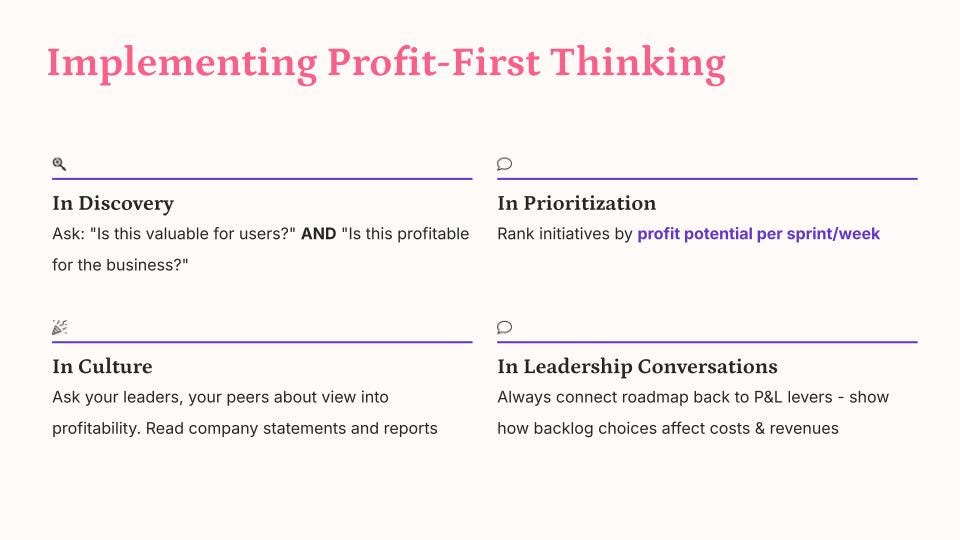
During discovery: Ask not just “Is this valuable for users?” but also “Is this profitable for the business?”
In prioritization: Rank initiatives by profit potential per sprint or per week—not just by user impact.
Set the culture: Ask your leaders, your peers, for a view into profitability. Read company statements and reports if your company is public.
Bandan used to read Booking.com’s income statements even though nobody asked him to.
“I used to read Booking.com’s income statements to see how much it cost to build this accommodations business. I also started looking at how much of direct costs are going in, how much of what is driving Booking.com’s profitability, what is not. These are all amazing things that help me today.”
At the time, nobody cared that he was doing this. He wasn’t responsible for it. But today, that self-education became his competitive advantage.
In leadership conversations: Always connect your roadmap back to P&L levers. Show how your backlog choices affect costs and revenues.
When Bandan encounters shared costs (like infrastructure spread across multiple products), he partners with finance and accounting to get answers.
“You need good partners in the organization. For me it was not my product leader, they were my finance and accounting counterparts that would help me out with my questions.”
One surprising thing: in his direct costs, he had to account for other product teams’ contributions. His product was part of a value chain. To deliver revenue, the full chain mattered—not just his piece. So 10% of another product group’s cost became part of his direct costs.
Action item: Schedule time with your finance counterpart this week. Ask: “How is my product viewed in the full product portfolio?” Request a view into your product’s profitability, even if it’s just directional.
What This Means for Your Career
Profitability isn’t a dirty word. It’s resilience.
When downturns happen—COVID, AI disruption, whatever’s next—profitable companies survive. They don’t have to cut half the team when VC funding dries up or interest rates rise.
“Profitability ensures resilience. When there’s a downturn, when things are bad, you’re able to fight a lot of these downturns as a company.”
Product managers used to be able to ignore all of this. Growth solved everything—or seemed to. But the playbook requires a new chapter now.
Business viability and customer delight have to go hand in hand. And Bandan suggests overindexing on business viability for a while—especially if you’re moving into senior product roles where you’re closer to stakeholders making P&L decisions.
The message isn’t to abandon customer delight. It’s to add the other half of the equation that’s been missing.
“Creating sustainable businesses is not always about customer delight. It’s also about building a business at the end of the day.”
Start with one thing: know your unit economics. Work backward from there.
The product managers who thrive in the next decade won’t just be the ones who can optimize conversion and drive MAUs. They’ll be the ones who can build products that are profitable, resilient, and sustainable.
Connect with Bandan Singh:
Substack: Bandan Singh
LinkedIn: Bandan Singh

Thanks for underlying that point! The toughest part is generally isolating the true value your product brings from the overall corporate overheads.
The gross profit vs net profit distinction is key here. Most PMs I know stop at revenue and never connect their work to actual profitability. That payback period framework is simple but brutal, especially when you realize half your backlog might have terrible payback. The shift from growth at all costs to sustainable unit economics isn't just macro driven, it's what separates PMs who survive from those who get caught flat-footed when the next downturn hits.