

Let me start with the honest version.
It started last year. I was drowning in content. LinkedIn was making my life a little miserable. Not in a dramatic way. In the slow, background-hum way where you check it too many times a day, absorb a lot of noise, and never quite feel like you have a real picture of what’s happening. The FOMO was low-grade but constant. I’d read something interesting and immediately lose it in the feed. I’d have a conversation with a community member about a trend and realize I had no system for capturing any of it.
This year it got worse before it got better.
I also tried to build a voice agent last year. The idea was to collect the needs of potential mentors and speakers: what topics they cared about, where they wanted to go, what conversations would be worth having. It didn’t work. The timing was off, the tooling wasn’t ready, and honestly I was trying to build a product when what I needed was a workflow.
This year is different. I made a deliberate decision to stop building new things and focus on scaling what we have. The conference in September, the Leaders Studio, the community. That means saving budget for an extra person to help with operations. It means being honest that I can’t do everything myself and getting serious about what I actually need systems for.
That shift in framing is what made Productlab FM possible.
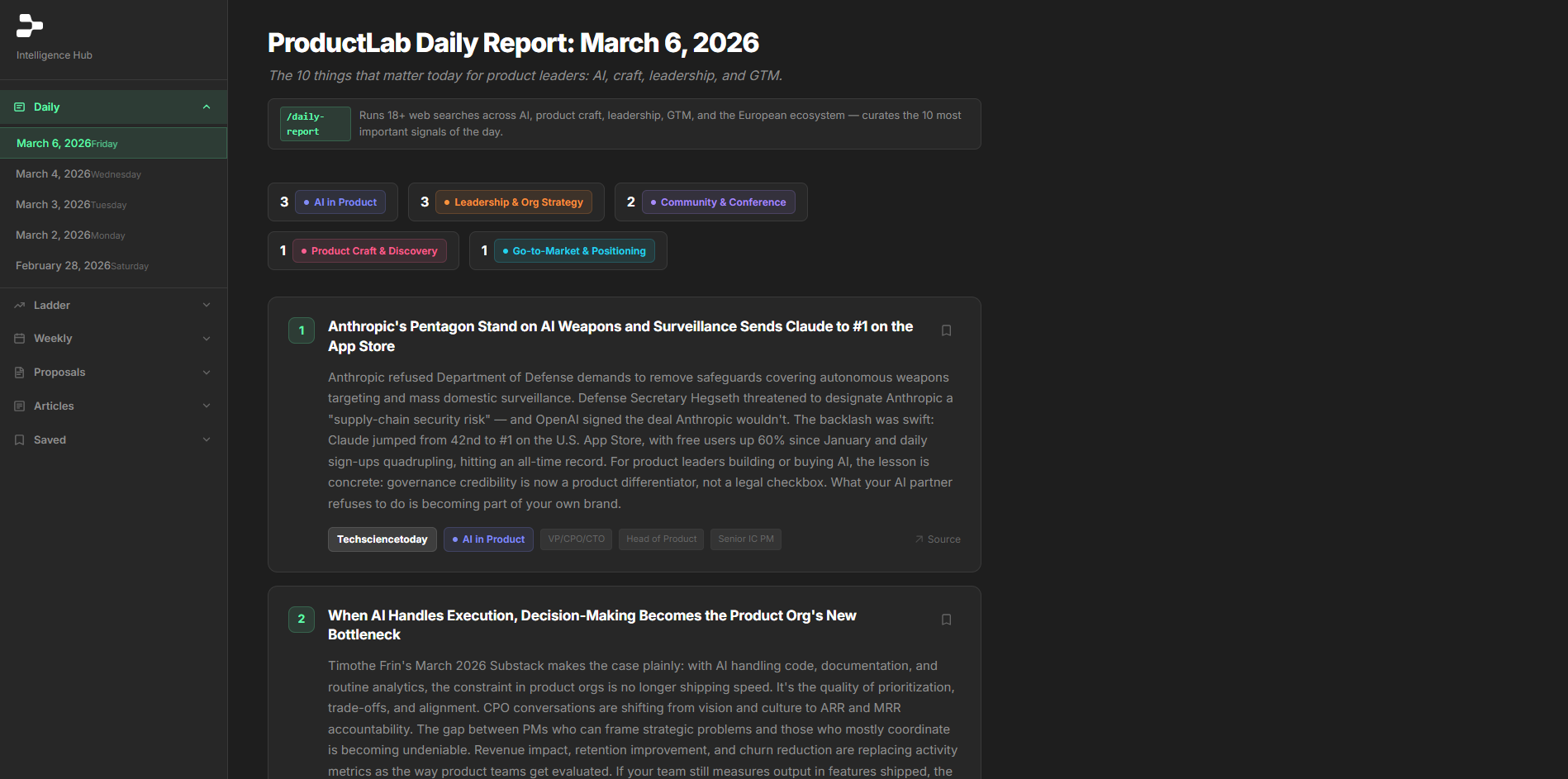
Finding a partner in crime
I didn’t build Productlab FM on my own. I want to be clear about that because the “founder teaches themselves to code” narrative is usually polished nonsense.
Pranav Pathak, who has been helping me with technical work, spent a weekend building something for himself: a skills management setup, a dashboard, a folder structure for organizing Claude’s outputs. He built it because it solved his problem. I looked at it and realized it could solve mine too, with some adaptation.
That’s the real version of “vibe coding” as a non-technical founder. You find someone who has already solved an adjacent problem, you understand what they built, and you shape it to your actual workflow. The hardest part wasn’t the technology. It was finding the headspace to actually do the work. Training myself on something new, figuring out what I actually needed versus what I thought I needed, and resisting the urge to keep testing and re-testing instead of committing to a direction and moving forward. I have spent more hours than I want to admit cycling through iterations that didn’t go anywhere because I hadn’t been honest enough with myself about the real problem.
The AHA moment that fit my workflow.
It wasn’t some breakthrough feature. It was the dashboard fetching all my newsletters without breaking. Just: it worked, it kept going, it didn’t need me to intervene. That’s it. After months of information management being a manual, scattered, slightly chaotic process, something ran on autopilot and I felt the weight of it lift.
I also want to mention the Claude thing that nobody talks about: 20 euros a month is not enough credit for two hours of serious work. I burned through it faster than I expected. I switched to the 90-euro plan. That’s the real cost of using this properly, and I’d rather say it out loud than let someone else discover it the hard way.
Important Step to follow
Make sure all the file are really organize by the tasks you want to do, otherwise things go messy. The small the best.
Build everything as a skill, so you can recall it
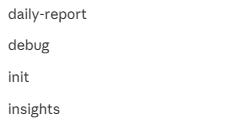
Some of the new Skills :) Deduplication Strategy for Content Systems

What Productlab FM actually does for me has almost nothing to do with time.
I thought it was going to save me hours. Maybe it does, somewhere. But the real value is mental capacity. I have a system that scans the market every day, curates what’s actually signal versus noise, and gives me a structured view of what’s happening without me having to go looking for it.
That means I stay off LinkedIn more. That means I have a safer, quieter work environment. That means I can think.
It also sharpens the questions I ask potential speakers and community members. When you have context on what’s moving in the field, you stop asking generic questions and start asking real ones. That matters a lot when you’re trying to build a speaker lineup of practitioners, not performers.
The other thing it does: it helps me get my own thinking out.
When I write something down and work through it in conversation with Claude, it asks me questions that push me further than I’d go alone. The output that comes from that process is more honest than what I’d produce if I just sat down to write content. And when honest writing goes out into the newsletter or on LinkedIn, something happens. People respond. Not with likes, with actual messages. Conversations that continue at events, on WhatsApp, in the community. People who feel like there’s a builder out there dealing with the same things they deal with.
That’s the loop I was trying to build. Not a content machine. A system that helps me stay close to what matters, think more clearly, and share enough of the real experience that the people in this community recognize themselves in it.
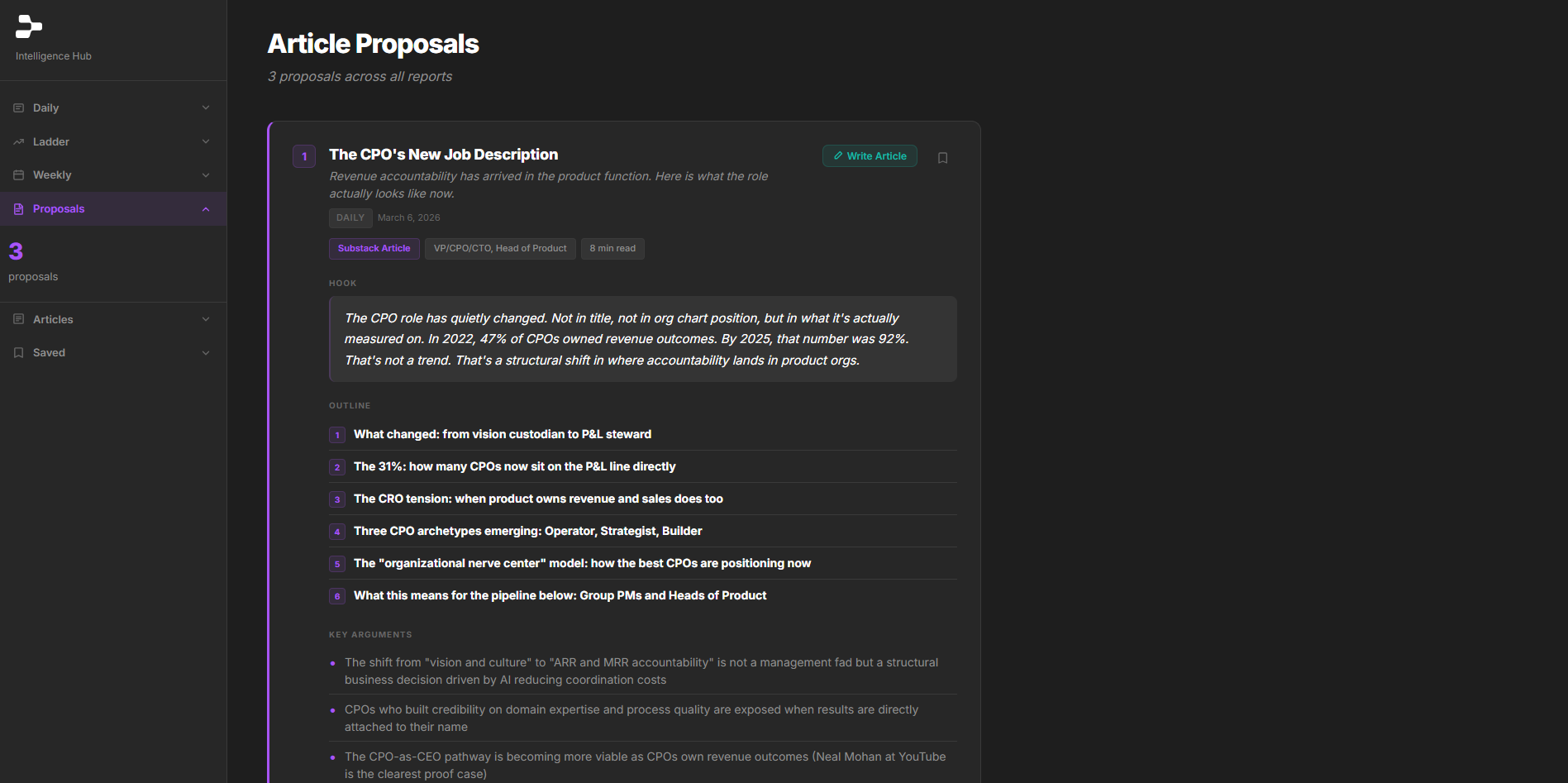
The foundation is there, it’s working, and I’m about to start using it properly. The newsletter you’re reading right now is the first output of that system running as designed.
I’ll keep reporting back on what works and what doesn’t. That’s the deal.
With love from Berlin & Amsterdam
Daniele and Pranav