

“It is extremely difficult to maintain a circle of competence without an outside perspective.”
The Great Mental Models, Volume 1 (Farnam Street)
Atul Gawande, one of the best surgeons in the United States, hired a coach. It was embarrassing, because nobody had evaluated him in over a decade. It showed him where his technique fell short, which nobody else would have pointed out.
Gawande’s craft changes slowly. Ours doesn’t, so the edge of what you know well keeps shifting. And the people who used to tell you where you were off now hear less: teams ask the AI before their manager, organisations get flatter, and a leader with 12 or 50 direct reports can’t watch each person’s work. Your blind spots grow while the signals thin. That’s when an outside view stops being a luxury.
Here are three from the last two months: a conference talk, a founder interview and a post. It’s a small sample, mostly European, mostly product and engineering. Treat it as a bet.
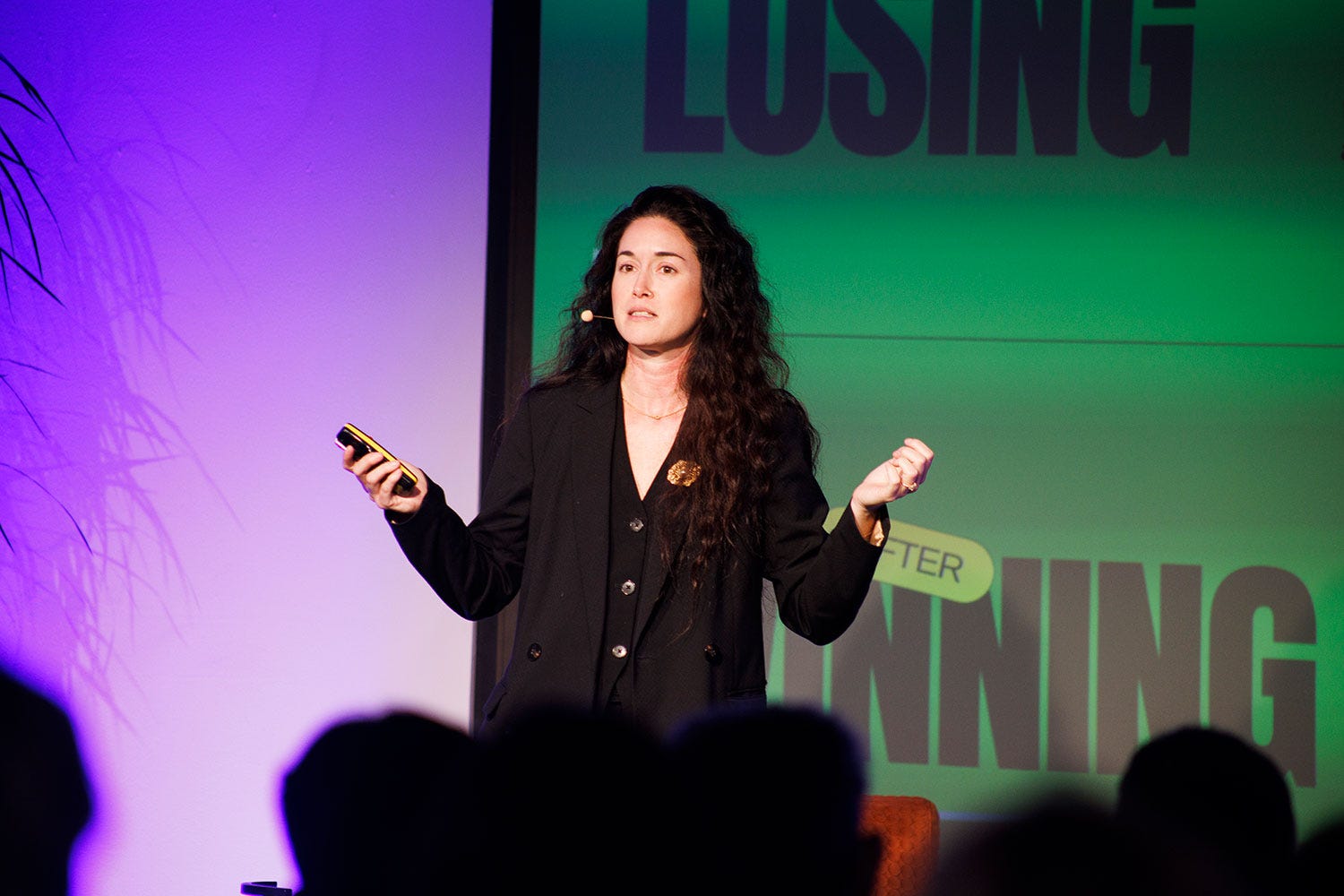
1. Decisions have become the expensive part
Csaba Tamas, Productlab Conference 2026
AI gave everyone a bakery overnight. Nobody checked whether the neighborhood wanted bread. A faster oven doesn’t create hungry customers.
In April, an AI company had 97% of its software changes written by AI and got about 30% faster, according to research its product and engineering chief, Csaba Tamas, cited. He told more than 300 of us in Berlin why: AI cut the cost of execution, and left the cost of coordination where it was.
His fix comes from Lockheed’s 1943 jet-fighter project, where 23 engineers with direct access to the decision makers finished in under 180 days:
Write down why you decided, not only what, so a team can decide again when the inputs change.
Measure the wait. A team blocked on a decision means “five people and 15 AI agents” standing still. His company cut decision latency from many months to a couple of weeks, and he wants days.
Ravi Mehta said in his keynote that a good AI feature starts from an unmet customer problem. Choosing which one is worth building is a decision, and decisions are the part that stayed slow.
We did this too. This year Productlab pushed content hard and left no time to ask what any of it meant. After the conference we slowed down.
The blind spot: I can’t see how long my own decisions wait, because I’m the one making them. Csaba put a number on it. Someone outside the decision does the same job.
2. Flat organisations need leaders who stand closer
Nik Storonsky, Revolut’s founder, at Wave by Vento
Nik described about 50 direct reports and teams of roughly 10. He sometimes works with developers and designers directly. His test: you should be able to play almost any instrument in the orchestra, or you can’t hear who is off key.
Csaba landed nearby. His engineering managers lead 10+ or more engineers, and two engineers with 15 agents make a team of 17 for the product manager.
My bet is that the coaching and unblocking middle managers used to carry goes nowhere in many companies, and “flat” quietly becomes “unowned”.
Both leaders also said what they haven’t solved. Nik said the systems he built around people may have to be thrown away. Asked where his workflow breaks, Csaba said he didn’t know yet. That’s an outside view taken on purpose.
3. The manager’s job becomes orientation

Her claim: producing work is now cheaper than coordinating it.
Managers hear fewer questions, because people ask the AI.
Experts get buried judging AI output.
A leader’s job becomes orientation: helping a group see the same situation and agree on what it means.
It connects to the book page. Gawande couldn’t see where he was suboptimal until someone told him. A manager whose team asks the AI loses a signal like that. Her answer is a system that records decisions and has the people involved confirm them, an outside check built into the work. (She sells that product, and I read a summary, so read the post yourself.)
What this adds up to
All three leaders have less information from below and make more decisions, faster. Gawande’s coach gave him two things: he saw where his technique fell short, and he gave better feedback to others. The book adds that it takes courage to ask, and that when you feel defensive you should focus on the result you want.
I’m doing this myself. I read books on mental models to frame problems in new ways, and I hired a coach to help me with the ambition to grow Productlab beyond Berlin. It comes with a lot of fear and a lot of uncertainty. Sound familiar?
I believe more than ever that Europe needs a new generation of product leaders, built by seeking outside perspective on purpose.
Check out the Leaders Circles. In January 2027 we start a hand-matched Circle of 10 to 12 product leaders on the way to Head of Product. You meet online every two weeks for 13 weeks, with two private coaching sessions, under a confidentiality agreement. Prefer to work one to one? 1:1 coaching is available on demand.
→ See how a Leaders Circle works
Try this on Monday
Pick the last decision that waited longer than it should have. Write down how long it waited, then ask one person outside your team to look at it with you. Hit reply with what they saw that you didn’t. I read those first.
Ready for more than one conversation? Apply to the January 2027 Leaders Circle, or book a 1:1.
Daniele
How I make this
Lately I’ve been taking time off to learn: talks, new books and podcasts, to understand how things are changing. I read, watch and listen to what I mention here myself, and I put it down on paper to decide what is worth sharing with you.
The text is AI-supported by Claude. It helps me structure and write from my notes and sources, and I decide what goes in.
Sources
The Great Mental Models, Volume 1 (Farnam Street), pp. 56 to 57. Quoted once, otherwise paraphrased.
Csaba Tamas, “Execution Is Cheap. What now?”, Productlab Conference 2026, 17 September. The ~30% comes from research he cited.
Ravi Mehta, “Building AI Products Competitors Can’t Match”, Productlab Conference 2026 keynote.
Nik Storonsky and John Elkann, Wave by Vento 2026. Revolut figures are Nik’s own statements.
Vanessa Meyer, How AI-native companies are rebuilding the management function, 5 October 2026.
Productlab, Leaders Circles and 1:1 Leadership Coaching.